
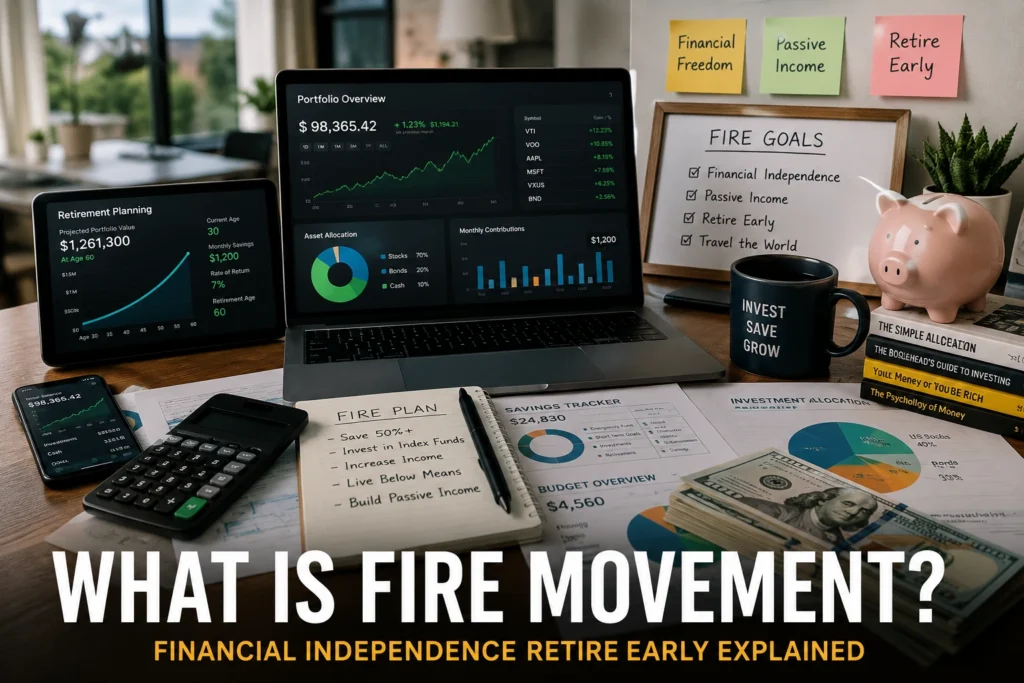
Imagine waking up on a Tuesday morning with nowhere you have to be, no boss to report to, and a portfolio that quietly covers every bill. That is the promise at the heart of the FIRE movement – Financial Independence, Retire Early. What started as a niche idea among frugal internet communities has grown into a global financial philosophy embraced by engineers, teachers, nurses, and entrepreneurs alike.
In 2026, with rising inflation, gig-economy jobs, and easy access to low-cost index funds, more people than ever are asking a simple but powerful question: do I really have to work until 65? This guide breaks down exactly how FIRE works, the types that fit different lifestyles, and the practical steps to begin your own journey toward financial freedom.
What Is the FIRE Movement?
The FIRE movement is a personal finance strategy built on two connected goals: accumulating enough invested wealth to cover living expenses indefinitely, and leaving traditional full-time employment far earlier than the conventional retirement age of 60 to 65.
The concept draws its intellectual roots from Vicki Robin and Joe Dominguez’s 1992 book Your Money or Your Life, which reframed money as a representation of life energy. The term FIRE itself was popularised through online communities in the early 2010s and has since spawned countless blogs, podcasts, and dedicated subreddits.
At its core, FIRE rests on a deceptively simple loop: earn money, spend far less than you earn, invest the difference consistently, and eventually live off the returns generated by your growing portfolio.
What Financial Independence Actually Means
Financial independence is the state in which your passive income – primarily investment returns and dividends – covers your total monthly expenses without any requirement to trade your time for a pay cheque. At this point, work becomes optional rather than obligatory. You might still choose to work, but you no longer must.
This freedom fundamentally changes how people relate to jobs, risk, and everyday decisions. A financially independent person can decline an unethical assignment, pivot to a lower-paying passion, or take a sabbatical without financial anxiety.
What “Retire Early” Really Means in Practice
Retiring early in the FIRE context rarely means sitting idle. Most people who reach FIRE transition into flexible consulting, creative projects, travel, volunteering, or building small businesses on their own terms. The key word is choice. Early retirement eliminates the need to exchange most of your waking hours for the income required for survival.
Many FIRE practitioners retire in their 30s or 40s – some even earlier – having built portfolios large enough to sustain them for 40 to 60 years.
How Does the FIRE Movement Work?
The mechanics of FIRE revolve around four interconnected levers that you pull simultaneously. The more aggressively you apply each lever, the shorter your path to financial independence.
High Savings Rate: The Engine of FIRE
Where conventional financial advice suggests saving 10 to 15 percent of your income for retirement, FIRE practitioners target 50 to 70 percent or higher. That dramatic difference compresses the timeline from 30-plus years to as few as 7 to 15 years.
Achieving a high savings rate requires meticulous expense tracking, ruthless separation of needs from wants, and a willingness to question lifestyle choices that most people treat as non-negotiable. Popular tools include zero-based budgeting apps and detailed monthly expense audits.
The Role of Compound Interest
Compound interest is the mathematical force that transforms aggressive saving into genuine wealth. When your investment returns are reinvested, those returns themselves begin generating returns in an exponentially growing cycle.
Future Value = Present Value × (1 + r)ⁿ
A simple illustration: a one-time investment of $1,000 at 7 percent annual growth becomes approximately $3,870 after 20 years, and $7,612 after 30 years – without adding a single extra dollar. Regular monthly contributions multiply this effect dramatically.
Best Investment Vehicles for FIRE
Most FIRE investors favour low-cost, diversified instruments that require minimal active management.
- Index funds tracking broad markets such as the S&P 500 or total world index
- Exchange-traded funds (ETFs) that offer flexibility and tax efficiency
- Dividend-paying stocks that generate regular passive income
- Real estate, either direct ownership or through REITs, for rental income and appreciation
- Tax-advantaged retirement accounts such as a 401(k), IRA, NPS, or PPF depending on your country
Types of the FIRE Movement
FIRE is not a single rigid path. Several distinct variants have emerged to suit different income levels, risk appetites, and lifestyle preferences.
Lean FIRE
Lean FIRE targets financial independence on a modest budget, typically below $40,000 per year in annual spending. Practitioners embrace a minimalist lifestyle, reducing housing costs through house hacking, keeping food bills low, and eliminating most luxuries. It is achievable on a lower income but requires sustained frugality in retirement.
Fat FIRE
Fat FIRE aims for a comfortable, sometimes lavish retirement lifestyle, targeting annual spending of $80,000 to $150,000 or beyond. This approach demands a significantly larger portfolio and usually a high-income career, but it removes the need for post-retirement lifestyle sacrifices.
Barista FIRE
Barista FIRE occupies a middle ground. The investor accumulates a partial portfolio sufficient to reduce retirement expenses significantly, then supplements investment income with part-time or flexible work. The term originates from the concept of holding a low-pressure job – like at a coffee shop – primarily for the health insurance and social interaction, rather than for financial need.
Coast FIRE
Coast FIRE focuses on investing aggressively early in life and then allowing compound growth to carry the portfolio to a full retirement number by a traditional retirement age – without any further contributions. Once the Coast FIRE number is reached, the investor can downshift to a lower-stress job or reduce hours, confident the portfolio will grow on its own.
How to Calculate Your FIRE Number
Every FIRE journey begins with calculating a specific savings target called the FIRE number. This figure represents the total invested portfolio size required to sustain your chosen lifestyle indefinitely.
The most widely used method is the 25x rule, derived directly from decades of retirement research.
FIRE Number = Yearly Expenses × 25
If your current annual expenses are $40,000, your FIRE number is $1,000,000. If you live on $60,000 per year, you need $1,500,000. The calculation forces clarity about your actual spending and gives you a concrete milestone to pursue.
The 4% Withdrawal Rule
The 25x rule is the mirror image of the 4% withdrawal rule, which originates from the Trinity Study – a landmark 1998 academic paper examining historical retirement portfolio survival rates. The study found that withdrawing 4 percent of an investment portfolio annually had an extremely high historical probability of lasting 30 or more years across varied market conditions.
Annual Safe Withdrawal = Investment Portfolio × 4%
It is important to understand that the 4% rule is a guideline, not a guarantee. Early retirees with 40 to 50 year retirement horizons sometimes use a more conservative 3 to 3.5 percent withdrawal rate. Inflation, sequence-of-returns risk, and unexpected healthcare expenses must all factor into your planning.
Step-by-Step Guide to Starting Your FIRE Journey
Step 1: Build a Detailed Monthly Budget
Before you can save aggressively, you need an accurate picture of where your money goes. Track every rupee or dollar for at least two to three months using an app or spreadsheet. Categorise expenses as essential (rent, food, utilities), discretionary (dining out, subscriptions), and avoidable (impulse purchases). This audit almost always reveals surprising opportunities to reduce spending without meaningful lifestyle impact.
Step 2: Build an Emergency Fund First
Before investing a single rupee for FIRE, establish an emergency fund covering three to six months of living expenses in a liquid, interest-bearing account. This buffer prevents you from selling investments at a loss during unexpected setbacks like a job loss, medical emergency, or major repair. Your emergency fund is the financial foundation that keeps your long-term plan intact.
Step 3: Eliminate High-Interest Debt
High-interest debt – credit cards, personal loans, payday loans – is the single greatest drag on wealth accumulation. A credit card charging 36 percent annually requires a 36 percent guaranteed investment return just to break even Rapidly pay off high-interest debt before allocating extra income to FIRE investments.
Step 4: Grow Your Income Streams
The savings rate equation has two variables: spending and income. Most FIRE guidance focuses on cutting expenses, but increasing income is equally powerful Typical approaches involve discussing a salary increase, cultivating a valuable freelance skill, creating a digital product, turning a creative hobby into profit, or earning rental income. Each rupee of additional income that does not trigger lifestyle inflation compresses your FIRE timeline.
Step 5: Invest Consistently and Automatically
Set up automatic transfers on every payday so money flows into your investment accounts before you have a chance to spend it. In India, Systematic Investment Plans (SIPs) in mutual funds or direct equity index funds are practical entry points. In global markets, inexpensive brokerages providing index ETFs perform effectively.Consistency over 10 to 20 years – even during market downturns – is far more important than trying to time the market perfectly.
Key Benefits of the FIRE Movement
- Complete financial freedom with no dependence on a single employer for survival
- Dramatically reduced workplace stress and more control over daily time
- Opportunity to pursue meaningful work, creative passions, or community projects
- More present and intentional parenting and family relationships
- Resilience against economic downturns, because your income does not depend on a job market
- Long-term health benefits linked to lower chronic stress and more time for exercise and rest
Real Risks and Disadvantages of FIRE
FIRE is a powerful strategy, but it carries genuine risks that deserve serious consideration.
- Market volatility: a prolonged market downturn early in retirement can permanently damage a portfolio through sequence-of-returns risk
- Inflation: sustained inflation erodes the real purchasing power of a fixed withdrawal, making the 4% rule less reliable over multi-decade horizons
- Healthcare costs: in countries without universal healthcare, medical expenses represent an enormous and unpredictable retirement risk
- Burnout: maintaining a 60 to 70 percent savings rate for years requires intense discipline and can create social isolation or personal strain
- Underestimating expenses: many early retirees discover actual retirement spending differs from projections, especially as family circumstances change
Will the FIRE Movement be Realistic in 2026?
Spread of living costs, persistent high inflation and volatile markets make financial independence harder these days than it was ten years ago, say FIRE sceptics. This is correct – for many families the journey is harder. But, the basic math of FIRE remains the same, and there are concrete benefits to FIRE in 2026 as well.
It is easier than ever to access low cost global index funds, even in tier-2 and tier-3 cities in India.With little initial investment, digital entrepreneurship is a source of income. With remote jobs, geographic arbitrage is possible, so that professionals in India can earn Indian dollars, but pursue FIRE numbers based on Indian cost of living.
The disparity between the earnings of middle class in the urban areas and the comfortable but frugal lifestyle creates a scope of meaningful savings rate for the households that dare to say no to the consumption culture around them in the Indian context. Most people in India have a longer path to take to get to FIRE, but they do have a path.
FIRE Movement Tips for Beginners
Gain as early as possible, at age 25 vs. 35, it’s more valuable than nearly any other factor.
Don’t inflate your lifestyle: as your salary increases, don’t keep going up on your home, car, etc. and your entertainment.
The easiest money saving habit that sets FIRE achievers apart from others.
•Spread your investments widely: Do not invest your money in a single stock, a specific sector or an asset class and risk your entire financial position.
•Check your plan once a year: recalculate your FIRE number when your expenses change, and adjust your plan as necessary
•Join a community: Online FIRE communities offer you accountability, ideas and a common language—all of which help keep you motivated
Conclusion
The FIRE movement doesn’t involve getting rich quick or being anti-ambitious. It’s a deliberate and mathematically grounded approach to reclaiming your time. The basic rules are simple: spend less than you make, put the surplus where it can be invested over time at little or no cost over diversified assets and let compound interest do the work over the years and decades.
It takes discipline, patience and a determination to think about success in your own terms instead of society’s. For those who make the dedication, the destination of such a transformative journey – having full control over every minute of the day the next morning – is one of the most significant ones that money can buy. It’s always the right moment; yesterday was the perfect time to begin. Now is the second best time.
Frequently Asked Questions
Q1. So what is the FIRE movement about in a nutshell?
FIRE stands for Financial Independence, Retire Early.It is a process of saving and investing a considerable amount of income that will allow investment returns to support all your living expenses, allowing you to opt out of working for money.
Q2. What is the amount of money necessary to reach financial independence and retire early (FIRE)?
Multiply all of your annual costs by 25. If you spend $40,000 per year, your FIRE number is $1,000,000.This will depend on your lifestyle, country of residence and retirement time.
Q3. What are the various kinds of FIRE?
The four are Lean FIRE (low budget lifestyle), Fat FIRE (comfortable or lavish lifestyle), Barista FIRE (partial portfolio and part-time job), and Coast FIRE (invest early and watch the compound growth).
Q4. Can middle-income workers make FIRE a reality?
Certainly, if you maintain a strong savings rate, manage your budget effectively, and are consistent with your investments. For average earners, it can take anywhere from 15 to 25 years, but many middle-class households have FIREd.
Q5. What does the 4% Rule mean in FIRE?
The 4 per cent rule states that, in retirement, you can withdraw 4 per cent a year from your investment portfolio with a high historical probability that it will last 30 years or more. It influences your exit plan and savings goal.
Q6. What investments are best for the FIRE movement?
The most popular FIRE investments are broad-market index funds and ETFs, which are also low-cost and diversified. Other stocks used are dividend stocks, real estate, and tax advantaged retirement accounts such as 401k, IRA, NPS, PPF, etc.