
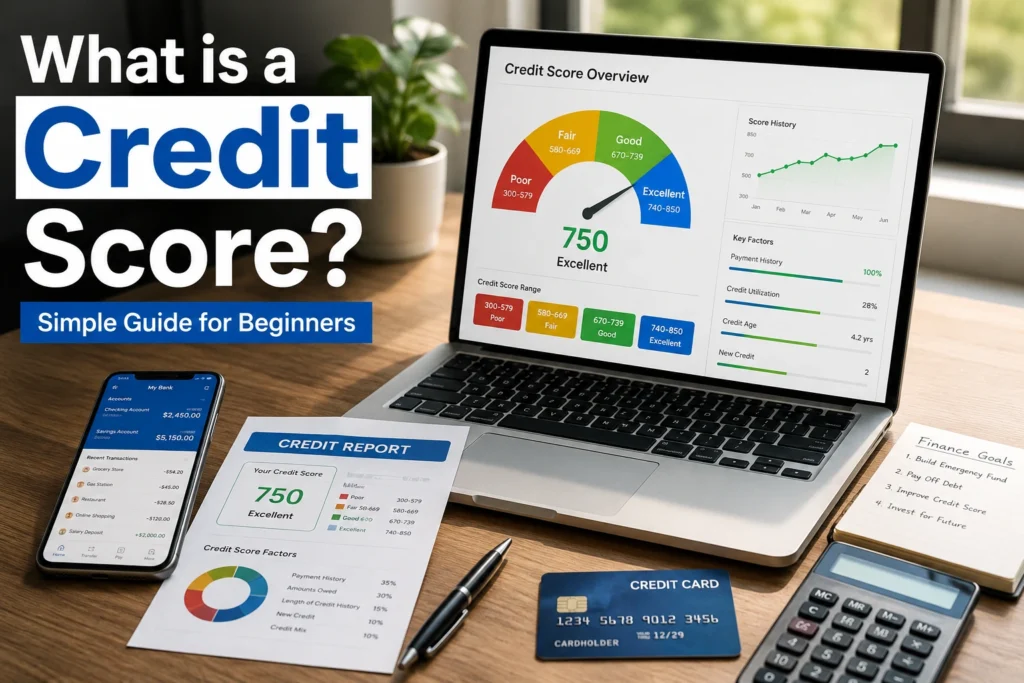
Have you ever applied for a loan or a credit card and wondered why the bank approved one person instantly while making another wait or even saying no? The key of the answer lies in three digits your credit score.. Whether you are just starting your financial journey or trying to understand why your loan application got rejected, this guide breaks everything down in the simplest possible way.
In India, your credit score most commonly referred to as your CIBIL score plays a central role in almost every financial decision a lender makes about you. By the end of this guide, you will know exactly what a credit score is, how it is calculated, why it matters, and most importantly, how you can build or improve yours.
What is a Credit Score?
Credit Score Meaning Explained
A credit score is a three-digit number that represents your creditworthiness in simple terms, how reliably you handle borrowed money. It is generated by credit bureaus based on your borrowing and repayment behavior. The number typically ranges between 300 and 900 in India.The higher your score is, the more trustworthy you will seem to lenders.
Consider it to be a financial report card. Just as your school grades reflected how well you performed academically, your credit score reflects how well you manage debt and repayment. Banks, NBFCs, and other lenders use this number to decide whether to approve your loan or credit card application and at what interest rate.
Why Banks and Lenders Check Credit Scores
Every time you apply for a personal loan, home loan, auto loan, or credit card, the lender pulls your credit score from a credit bureau. This allows them to assess risk in seconds. A good score indicates that you are a conscientious borrower and make timely payments. A low score suggests financial irregularities, making lenders hesitant to extend credit or they may do so at a much higher interest rate.
Difference Between Credit Score and Credit Report
Many beginners confuse these two terms. Your credit report is a detailed document that contains your complete borrowing history every loan, every credit card, every payment, and every missed due date over the past several years. Your credit score, on the other hand, is a single number calculated from the data in that report. Think of the credit report as the full story and the credit score as the summary on the front page.
How Does a Credit Score Work?
Credit Score Range Explained
In India, credit scores generally fall on a scale of 300 to 900. Here is how the ranges break down:
Credit Score Range | Category | What It Means |
300 – 549 | Poor | High risk; most lenders will decline |
550 – 649 | Below Average | Limited options; higher interest rates |
650 – 749 | Good | Decent approval chances with standard rates |
750 – 799 | Very Good | Strong profile; competitive interest rates |
800 – 900 | Excellent | Best rates and fastest approvals |
What is Considered a Good Credit Score?
A score of 750 or above is widely considered good across all major lenders in India. At this level, you are likely to qualify for loans quickly, get competitive interest rates, and receive pre-approved offers from banks. Most financial experts recommend aiming for and maintaining a score in the 750 to 850 range.
Poor vs Excellent Credit Score
A poor credit score (below 600) does not automatically disqualify you from all credit options, but your choices become very limited. You may face much higher interest rates, lower loan amounts, or be asked for additional guarantors. An excellent score above 800 puts you in the top tier of borrowers giving you negotiating power and access to the best financial products.
Factors That Affect Your Credit Score
Your credit score is not random. It is the result of specific financial behaviors tracked over time.These are the most important factors that determine it:
Payment History
This is the single biggest factor in your credit score typically accounting for around 35% of the total calculation. Every time you pay an EMI, credit card bill, or loan installment on time, it positively impacts your score. A single missed payment can drop your score significantly, especially if it is reported as a default or delinquency.
Credit Utilization Ratio
This refers to how much of your available credit limit you are actually using. When the credit card limit is Rs. If you have 100,000 balance then your outstanding balance is Rs.80,000, your utilization ratio is 80% which is considered high and can hurt your score. Keeping your credit utilization below 30% is generally recommended for a healthy score.
Loan Repayment Behavior
Timely repayment of all loans whether it is a personal loan, car loan, or home loan positively reinforces your credit profile. Lenders look at how consistently you have repaid debt across different types of credit over your entire credit history.
Hard Inquiries and Multiple Loan Applications
When borrowers apply for a loan or credit card, the lender makes an official inquiry that is recorded on the credit report; this is known as a hard inquiry. Each hard inquiry causes a small but measurable dip in your score. If you apply to multiple lenders in a short period, it can signal financial desperation to credit bureaus, further impacting your score negatively.
Length of Credit History
The longer your credit history, the better provided it reflects positive behavior. An account you have managed well for five years contributes more positively than one opened six months ago. This is one reason financial advisors suggest keeping older credit accounts active even if you rarely use them.
Why is a Credit Score Important?
Loan Approval Chances
Banks and financial institutions use your credit score as the first filter when processing loan applications. A score above 750 greatly increases your chances of loan approval, while a score below 650 can result in outright rejection or very limited options.
Credit Card Eligibility
Premium credit cards with travel rewards, cashback, and lounge access are usually reserved for applicants with strong credit profiles. Your credit score determines not just whether you get a card but also the credit limit you receive.
Interest Rates on Loans
This is where a good credit score can save you lakhs of rupees over time. Borrowers with higher scores are offered lower interest rates on home loans, personal loans, and auto loans. Even a 0.5% difference in interest rate on a 20-year home loan can mean a significant amount in total savings.
Financial Reputation and Trust
Beyond just banks, your credit score contributes to your overall financial reputation. Some employers and landlords in India now check credit scores as a measure of financial responsibility. A good score is indicative of financial discipline that can benefit not only in the ability to borrow, but in the ability to move forward.
What is a CIBIL Score?
Difference Between Credit Score and CIBIL Score
In India, the term CIBIL score is used almost interchangeably with credit score in everyday conversation. However, they are technically different. A credit score is a general term for any score produced by any credit bureau. The CIBIL score specifically refers to the score generated by TransUnion CIBIL, the most widely used credit bureau in India. Because CIBIL was the first and most prominent bureau in India, its name became synonymous with credit scores overall.
CIBIL Score Range in India
The CIBIL score is a range of 300-900. A score of 750 or above is considered ideal by most Indian lenders. CIBIL calculates your score based on data submitted by member banks and financial institutions every month.
Other Credit Bureaus in India
While CIBIL is the most recognized name, India has three other SEBI-registered credit bureaus: Experian, Equifax, and CRIF High Mark. Each bureau calculates scores using similar but not identical models, which is why your score may vary slightly across bureaus. Lenders may check scores from one or more of these bureaus depending on their internal processes.
How to Check Your Credit Score Online
Free Credit Score Checking Websites
In India, one can get their credit report from all four credit bureaus once a year for free. Several financial apps and platforms also offer free credit score checks, including Paisabazaar, BankBazaar, OneScore, and CRED. These platforms provide not just your score but also a breakdown of the factors affecting it.
Steps to Check CIBIL Score
Checking your CIBIL score is straightforward. Go to the official TransUnion CIBIL website or to a third party website. Fill in the details of the name, date of birth, PAN card number, and contact information. Verify your identity via OTP. Your score and a summary of your credit report will be displayed within minutes.
Soft Inquiry vs Hard Inquiry
Checking your own credit score is called a soft inquiry, and it does not affect your score in any way. It is available for check-out as many times as desired. Many hard inquiries, however, can indicate that you are a credit risk, since they are usually a sign of someone trying to get a lot of credit. and too many hard inquiries in a short time can reduce your score.
How to Improve Your Credit Score Fast
Pay EMIs and Bills on Time
The single most effective thing you can do for your credit score is to pay every due date without exception. Set up autopay or calendar reminders for all EMIs and credit card bills. Even one missed payment can take months to recover from.
Keep Credit Card Usage Low
Try to use no more than 30% of your total credit card limit at any given time. If you regularly spend close to your limit, consider requesting a credit limit increase this can lower your utilization ratio without requiring you to spend less.
Avoid Multiple Loan Applications
Each loan application triggers a hard inquiry. Instead of applying to five lenders simultaneously, use an eligibility checker tool to identify which lenders are most likely to approve you, and then apply selectively.
Maintain Old Credit Accounts
Resist the urge to close old credit cards that you no longer actively use. Keeping them open (with a zero or small balance) preserves your credit history length and your available credit limit, both of which benefit your score.
Correct Errors in Credit Report
Mistakes in credit reports are more common than people realize a payment marked as missed when it was actually made on time, or a loan that was already closed still showing as active. Review your credit report regularly and raise a dispute with the credit bureau if you spot any inaccurate information.
Common Credit Score Mistakes Beginners Make
Missing EMI Payments
This is the most frequent and the worst error. Life gets busy, but a forgotten EMI can leave a negative mark on your credit profile for years. Automate your payments wherever possible to eliminate this risk entirely.
Maxing Out Credit Cards
Using your full credit card limit every month signals to credit bureaus that you may be financially strained. High utilization is consistently one of the top reasons why otherwise responsible borrowers see their scores drop unexpectedly.
Closing Old Credit Cards
When you close an old credit card, you reduce your available credit limit and shorten your credit history both of which can negatively affect your score. Unless you are paying an annual fee on a card you never use, consider keeping older accounts open.
Ignoring Credit Reports
Many people never check their credit report until they are rejected for a loan. By then, it is too late to dispute errors or fix problems quickly. Make it a habit to review your credit report at least twice a year to stay ahead of any issues.
Tips to Build Credit Score From Scratch
If you have never taken a loan or owned a credit card, you may have no credit history at all which means no score. Here is how to start building one:
Use a Secured Credit Card
A secured credit card is backed by a fixed deposit you place with the bank. It works like a regular credit card, and your payments are reported to credit bureaus. This is one of the safest and most reliable ways to build a credit history from zero.
Start With Small Loans
Taking a small personal loan or a consumer durable loan (for example, an appliance purchase on EMI) and repaying it on time creates a positive track record. Some lenders specifically design entry-level credit products for first-time borrowers.
Build Responsible Financial Habits
Credit scores are ultimately a reflection of financial discipline. Spending within your means, saving consistently, and paying dues on time are the foundations. Good habits practiced over 12 to 24 months can produce a strong credit score even for someone starting from scratch.
Final Thoughts
Your credit score is one of the most powerful numbers in your financial life yet most people only think about it when they need a loan and find their application rejected. The good news is that credit scores are not permanent. With the right habits and a little patience, anyone can build or improve their score significantly over time.
Start by checking your credit score today. Understand where you stand. Identify what is helping or hurting your score. Then commit to consistent, responsible financial behavior. Whether you are 22 and just starting out, or 45 and rebuilding after a financial setback, the path to a great credit score is the same: pay on time, borrow wisely, and monitor your report regularly.
Financial health is not built overnight, but every responsible decision you make today moves your score and your financial future in the right direction.
Frequently Asked Questions (FAQs)
Q1. What is a good credit score in India?
A credit score above 750 is generally considered good in India. It improves your chances of loan and credit card approval and often qualifies you for lower interest rates. Scores between 800 and 900 are considered excellent and give you the best access to premium financial products.
Q2. How can I check my CIBIL score for free?
You can check your CIBIL score for free through the official TransUnion CIBIL website, which provides one free report per year. Several financial platforms such as Paisabazaar, BankBazaar, and OneScore also offer free credit score checks without affecting your score.
Q3. Can I improve my credit score quickly?
Yes, meaningful improvements are possible within a few months. Paying all EMIs and credit card bills on time, reducing your credit card utilization below 30%, and avoiding new loan applications are the fastest ways to see progress. However, a dramatic jump say from 550 to 800 typically takes 12 to 24 months of consistent good behavior.
Q4. What lowers your credit score?
Late or missed payments are the biggest factor. Other key contributors include high credit card utilization, defaulting on loans, closing old credit accounts, and making multiple loan applications in a short period, each of which triggers a hard inquiry.
Q5. Is CIBIL score and credit score the same?
Not exactly. A credit score is a general term for scores produced by any credit bureau. The CIBIL score is specifically the score provided by TransUnion CIBIL, which is the most widely used bureau in India. Other bureaus like Experian and Equifax also produce credit scores, which may differ slightly from your CIBIL score.
Q6. How long does it take to build a good credit score?
Building a strong credit score from scratch typically takes 12 to 24 months of responsible credit usage. If you already have a credit history and are recovering from a setback, the timeline depends on how severe the negative marks are and how consistently you practice good credit habits going forward.