
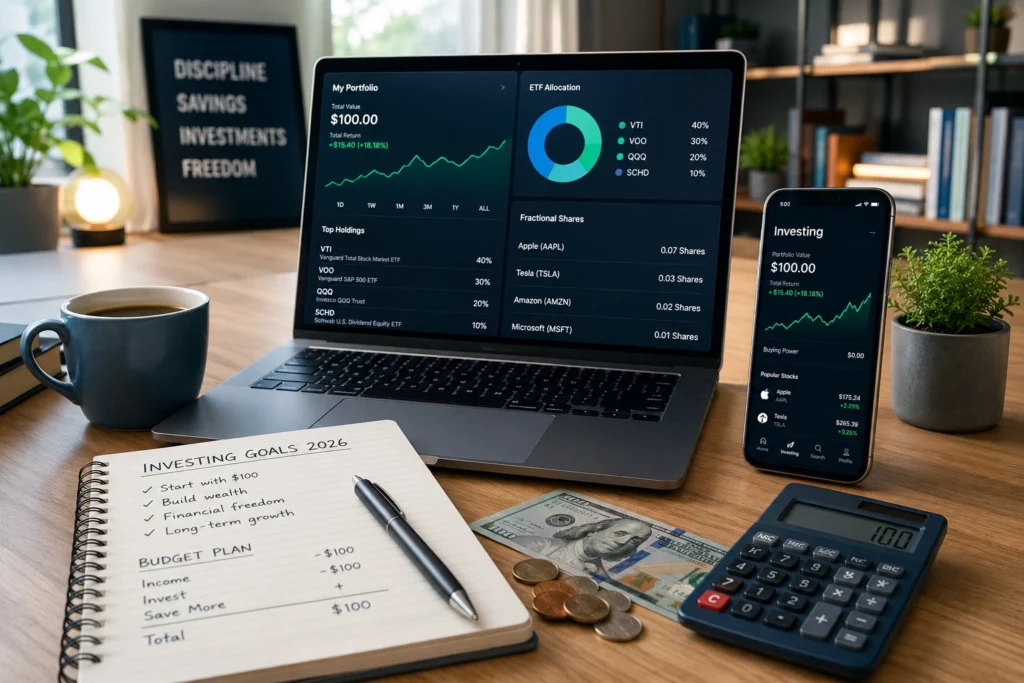
Many individuals believe that investing is reserved solely for the rich. They imagine Wall Street traders with six-figure accounts, or financial advisors who manage millions. That mindset prevents countless novices from beginning at all.
The truth in 2026 is completely different. You can open an investment account today with as little as $1, buy fractional shares of top companies, and start building real wealth from your phone. Technology has removed every traditional barrier to investing.
This guide will show you exactly how to invest your first $100 wisely, what options are available, which mistakes to avoid, and how to turn a small start into long-term financial freedom using smart, proven strategies.
Why You Should Start Investing Early
The Power of Compound Interest
Albert Einstein is said to have described compound interest as the eighth wonder of the world, and justifiably so. When your investment earns returns, those returns start earning their own returns. Over time, this snowball effect can transform a small amount into a surprisingly large sum.
For example, if you invest $100 today and add $100 every month at an average annual return of 10%, you would have roughly $76,000 after 20 years. The earlier you begin, the more years your money has to compound, which is why starting now with just $100 is far better than waiting until you have more.
Investing vs Saving Money
A savings account feels safe, but it quietly works against you in an inflationary economy. Most bank savings accounts offer 3 to 4 percent annually at best, while inflation in many economies runs at a similar or higher rate. This means your money’s purchasing power can stay flat or even shrink.
Investing, on the other hand, puts your money to work in assets that historically grow above the inflation rate over the long term. The stock market has averaged around 10 percent annually over the past century. Saving safeguards your funds; investing enhances them.
How Inflation Reduces Savings Value
Inflation refers to the slow increase in prices as time progresses.If inflation is 5 percent per year and your savings account pays 3 percent, you are effectively losing 2 percent of your purchasing power annually. $100 today will buy less in five years if left only in a standard savings account. Investing in assets like index funds or dividend stocks provides a hedge against this slow erosion of value.
Is it Possible to Begin Investing with Only $100?
Absolutely yes. In 2026, investing platforms have been completely redesigned around accessibility. Brokers like Fidelity, Robinhood, and Groww allow zero minimum deposits and offer fractional share investing, meaning you can own a piece of companies like Apple or Tesla with as little as one dollar.
Benefits of Low-Budget Investing
- You learn real market behavior with real money, which is far more effective than simulations.
- You establish steady investment practices early on, which are far more significant than the sum.
- You build emotional resilience by experiencing market ups and downs at low financial risk.
- Compound interest starts working from day one, regardless of the amount.
Common Myths About Small InvestmentsMyth:
“Minor investments aren’t valuable” Fact: Consistency is more important than quantity.100 invested monthly for 30 years can grow to over $200,000.
Myth: “Investing is overly dangerous for newcomers.” Fact: Diversified index funds have significantly lower risk than most individuals think, and inaction also involves risk due to inflation. nothing also carries risk through inflation.
Best Ways to Invest $100 in 2026
1. Invest in Index Funds
Index funds are groups of stocks that mirror a particular market index, like the S&P 500, encompassing 500 of the largest corporations in the United States.est US companies. When you buy an S&P 500 ETF (exchange-traded fund), you instantly own a tiny share of hundreds of companies, giving you broad diversification in a single purchase.
This is widely considered the best starting point for beginners because of its simplicity, low fees, and proven long-term track record. Popular choices include Vanguard’s VOO and iShares’ IVV, both of which have extremely low expense ratios.
2. Buy Fractional Shares
A single share of Amazon or Alphabet (Google) can cost hundreds or even thousands of dollars. Fractional shares let you invest in these companies with any amount. If Apple stock is trading at $200, you can invest $20 and own one-tenth of a share. This makes high-value stocks accessible to every beginner regardless of budget.
3. Use Micro-Investing Apps
Micro-investing platforms like Acorns automatically round up your everyday purchases and invest the spare change. Spend $3.60 on coffee, and Acorns invests $0.40 into a diversified portfolio. These apps are ideal for building the habit of investing without ever feeling the financial pinch.
4. Start a SIP or Mutual Fund
Investment
A Systematic Investment Plan (SIP) enables you to contribute a set sum to a mutual fund each month. Even $10 or $20 monthly into a well-chosen mutual fund builds significant wealth through dollar-cost averaging, where you automatically buy more units when prices are low and fewer when prices are high. Apps like Groww and Zerodha in India make SIP investing very accessible.
5. Invest in Dividend Stocks
Dividend stocks are shares in companies that pay regular cash payments to shareholders.Companies like Johnson & Johnson, Coca-Cola, and Realty Income have consistently paid dividends over numerous years. Reinvesting those dividends accelerates your portfolio growth through the compounding effect and builds a stream of passive income over time.
6. Cryptocurrency for Beginners (Optional)
Crypto remains highly volatile and unpredictable in 2026. While Bitcoin and Ethereum have delivered significant returns historically, they can also drop 50 percent or more in a short period. If you are curious, limit crypto to no more than 5 to 10 percent of your total portfolio, and only invest money you can afford to lose. Build your core portfolio with more stable assets first.
Step-by-Step Guide to Start Investing with $100
Step 1: Set Clear Financial Goals
Before investing make sure to know what you want to achieve. Are you saving for retirement 30 years from now? Building a down payment for a home in 5 years? Creating a passive income stream? The more aggressive or conservative, the more it is depending on the goal you are trying to achieve. Short-term goals (under 3 years) require safer, more liquid investments. Long-term goals allow you to take on more risk for higher returns.
Step 2: Build an Emergency Fund First
This is the most overlooked step for beginners. Before investing, ensure you have 3 to 6 months of living expenses saved in a high-yield savings account. If your car breaks down or you lose your job and have no emergency fund, you may be forced to sell investments at a loss. Your emergency fund is the financial safety net that lets you invest without fear.
Step 3: Choose an Investment App or Broker
Select a platform that fits your needs. Look for zero or low account minimums, fractional share investing, commission-free trades, educational resources, and a clean intuitive interface. The best app is one you will actually use consistently. Some great beginner options are discussed in the next section.
Step 4: Understand Your Risk Tolerance
Risk tolerance is how much market fluctuation you can handle emotionally and financially. If watching your portfolio drop 20 percent would cause you to panic-sell, you have a lower risk tolerance and should focus more on bonds and dividend stocks. If you can stay calm during volatility, growth-oriented index funds and ETFs may suit you better. Be honest with yourself about this.
Step 5: Diversify Your Portfolio
Don’t invest all in 1 stock or one sector. Diversification means spreading your investment across different asset types, industries, and geographies. Even with $100, you can achieve meaningful diversification by investing in an S&P 500 ETF, which gives you exposure to 500 different companies in a single purchase.
Step 6: Start with Small Regular Investments
Consistency beats amount every time. Set up automatic investments, even if it is just $20 or $50 per month. This is part of their super powers combined with compound interest and dollar-cost averaging, and how ordinary people become long-term wealth builders. builders. The key is to start and to never stop.
Best Investment Apps for Beginners in 2026
Features to Look For
- Low or zero commission fees so more of your money stays invested
- Fractional share investing to access any stock at any budget
- Clean, beginner-friendly interface that does not overwhelm you
- Educational tools like tutorials, articles, and risk calculators
Popular Beginner Investment Platforms
Robinhood (US): Commission-free trading with fractional shares and a very simple interface. Great starting point for US investors.
Fidelity (US): Zero minimums, excellent educational content, and strong long-term tools. Highly trusted for retirement accounts.
Acorns (US): Ideal for passive micro-investing. Rounds up purchases and invests spare change automatically.
Groww (India): Easy mutual fund and stock investing with SIP support. No minimum investment required.
Zerodha (India): It is one of the most popular discount brokers in India that has excellent tools for new investors as well as seasoned investors..
Beginner Investment Strategies That Work
Dollar-Cost Averaging (DCA)
DCA stands for dollar cost averaging which involves investing a set amount at fixed periods of time, irrespective of market conditions.When prices fall, your fixed amount buys more shares. When prices rise, it buys fewer. Over time, this naturally lowers your average cost per share and removes the dangerous temptation of trying to time the market. It is one of the most effective strategies for beginners.
Long-Term Investing Strategy
The longer you hold well-diversified investments, the higher the probability of positive returns. Market crashes happen, but historically, every major market crash in history has eventually recovered and gone on to reach new all-time highs. It is always better to be in the market than to try to time the market.
Passive Investing with ETFs
Passive investing means buying and holding index funds or ETFs rather than actively picking individual stocks. Studies consistently show that passive investors outperform the majority of active traders over 10-year periods, largely due to lower fees and the avoidance of costly emotional decisions.
Diversification for Risk Management
A diversified portfolio spreads risk across multiple asset classes. A simple beginner allocation might be 70 percent in a broad stock market ETF, 20 percent in bonds for stability, and 10 percent in alternative assets. As your portfolio grows and your knowledge deepens, you can adjust these proportions to match your evolving goals.
Common Investing Mistakes Beginners Should Avoid
Investing Without Research
Before putting money into any investment, understand what you are buying. Know the company’s business model, the index a fund tracks, or the risk profile of an asset class. Blind investing based on social media tips is one of the fastest ways to lose money.
Chasing Quick Profits
The desire to get rich quickly leads beginners into speculative assets, penny stocks, or high-risk trading strategies. Real wealth is built slowly through consistency and compounding. If an investment promises extraordinary returns with no risk, it is almost certainly a scam or a gamble.
Panic Selling During Market Drops
Dips in the market are part of the investing process.The investors who panic and sell during drops lock in their losses. Those who hold or even buy more during downturns are the ones who benefit most when markets recover. Emotional discipline is one of the most valuable skills an investor can develop.
Investing Emergency Money
Never invest money that you might need in the next 12 months. Markets can drop sharply in the short term. If an emergency forces you to sell at a low point, you could lose a significant portion of your principal. Always separate your emergency fund from your investment portfolio.
Low-Risk Investment Options for Beginners
- High-Yield Savings Accounts: Federally insured and easily accessible. Ideal for your emergency fund or short-term savings. Currently offering 4 to 5 percent APY in many institutions.
- Government Bonds: Loans to the government backed by the full faith of the issuing country. Very low risk, predictable returns. US Treasury bonds and I-bonds are popular choices.
- Index Funds and ETFs: Broad market exposure with built-in diversification. Low fees and historically solid long-term returns.
- Dividend-Paying Blue Chip Stocks: Shares in large, stable companies with long histories of paying regular dividends. Lower volatility than growth stocks.
How to Grow Your First $100 Faster
Reinvest Your Returns
Whenever you receive dividends or capital gains, reinvest them rather than withdrawing. This keeps the full power of compounding working for you. Most platforms allow automatic dividend reinvestment with a single toggle in your account settings.
Build Monthly Investing Habits
Treat your monthly investment like a bill you must pay. Set up an automatic transfer on payday so investing happens before spending. Even $25 or $50 per month builds meaningful wealth over years when compounded consistently.
Increase Contributions Over Time
As your income grows, increase your monthly investment amount. Going from $50 to $100 per month doubles your portfolio growth rate. Annual raises are a perfect opportunity to redirect a portion of that increase directly into your investment account.
Investing Trends to Watch in 2026
AI-Based Investing Apps and Robo-Advisors
Robo-advisors like Betterment and Wealthfront use algorithms to automatically build and rebalance a diversified portfolio based on your goals and risk tolerance. In 2026, AI has made these tools even smarter, offering personalized recommendations and tax optimization at very low fees. They are an excellent hands-off option for busy beginners.
Sustainable and ESG Investing
Environmental, Social, and Governance (ESG) funds allow you to invest in companies that align with your values. These funds have grown significantly in 2026 and many ESG ETFs now offer competitive returns alongside ethical standards. They are increasingly popular among younger investors who want their money to reflect their beliefs.
Digital Assets and Tokenized Investments
Tokenization of real-world assets like real estate, commodities, and private equity is a growing trend in 2026. Blockchain-based platforms now allow fractional ownership of real estate properties or fine art at very low entry points. This space is still maturing and in its infancy, but as it evolves and regulations are put in place, it will continue to be a space to be watched.
Conclusion: Your First $100 Is Just the Beginning
Starting your investing journey with $100 is not just possible in 2026, it is genuinely smart. You have explored the options: index funds, fractional shares, SIPs, dividend stocks, and micro-investing apps. You have learned the steps: set goals, build an emergency fund, choose a platform, understand your risk tolerance, diversify, and invest consistently.
The strategies are clear: dollar-cost averaging, long-term thinking, passive ETF investing, and disciplined diversification. The mistakes to avoid are known: panic selling, chasing quick profits, and investing money you cannot afford to commit.
The key to any project is not the amount of material you have.Initiating is essential, followed by progress.The greatest investing regret is almost always starting too late. Every day you wait is a day of compound interest you never get back.
Open your account today. Invest your first $100. Build the habit. And let time do the heavy lifting. Financial freedom is not reserved for the wealthy.It builds, one consistent investment at a time.
Frequently Asked Questions
Can I really start investing with only $100?
Yes. Many platforms today allow fractional shares, ETFs, and micro-investing with no minimum balance. $100 is more than enough to open an account and make your first investment.
What is the safest way to invest $100 for beginners?
Index funds and ETFs tracking the S&P 500 are widely considered the safest starting point due to built-in diversification, low fees, and a strong long-term historical track record.
Which app is best for investing small amounts?
Robinhood and Fidelity work well for US investors. Acorns is ideal for completely hands-off micro-investing. In India, Groww and Zerodha offer excellent beginner-friendly SIP and stock investing options.
Is investing $100 in stocks worth it?
Yes. Even a small amount teaches you real market behavior, starts your compounding journey, and builds the habits that matter far more than the initial amount invested.
Should beginners invest in crypto in 2026?
With caution and only a small allocation. Cryptocurrency remains highly volatile. Build a foundation in index funds and ETFs first, then consider adding crypto if you accept the higher risk.
How can I grow my $100 investment faster?
Reinvest all dividends and returns, add to your investment monthly using dollar-cost averaging, increase contributions as your income grows, and stay patient. Time and consistency are your greatest tools.